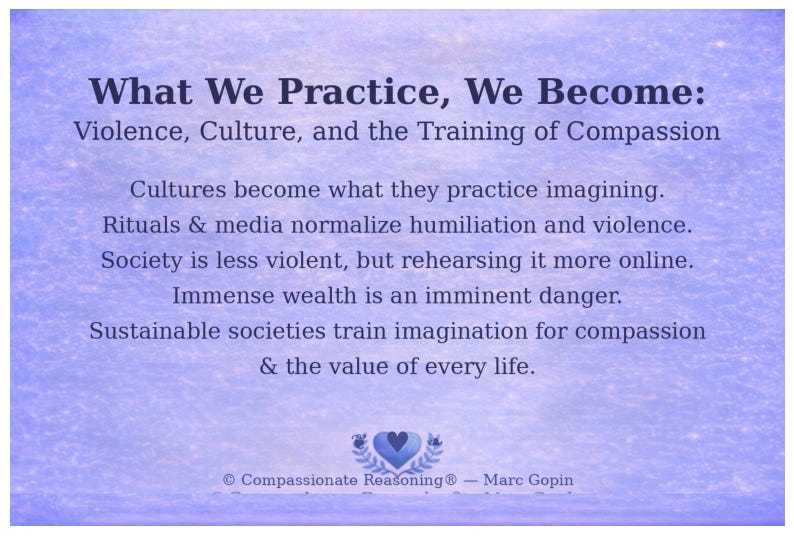
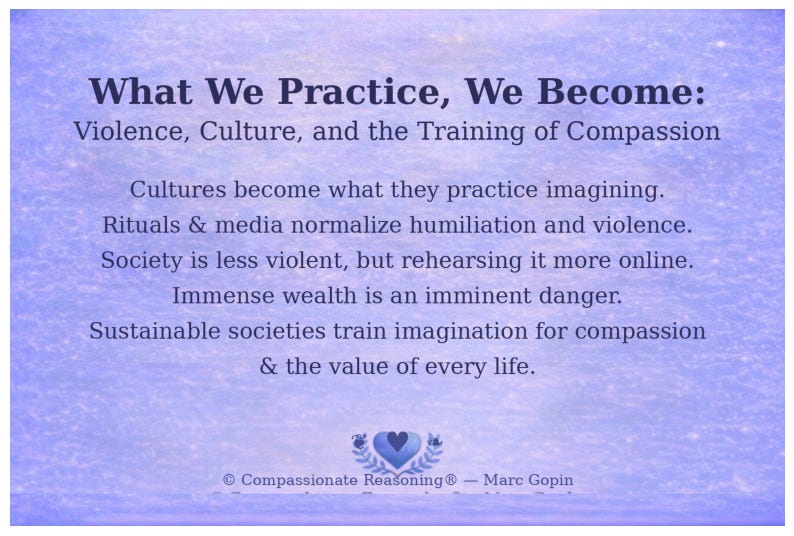
What We Practice, We Become:
Violence, Culture, and the Training of Compassion

Dear Reader, I am grateful for your presence. This essay is part of my hope to develop Compassionate Reasoning as a public philosophy and set of civic skills.
If you’d like to support this vision and help it reach wider audiences, please consider becoming a paid subscriber and recommending it to others.
Violence and the Popular Imagination: A Carnival of Devils
One winter evening, I found myself watching footage of a carnival procession in Swabia in southern Germany. The parade was not festive in the cheerful sense that outsiders often associate with carnival. Instead, the streets were filled with figures wearing carved wooden masks of devils, ghosts, skeletal faces, and grotesque creatures with horns and distorted expressions. The costumes were elaborate and deeply traditional, passed down through centuries in towns that take these rituals seriously. As the masked figures moved through the streets, ringing bells and shouting, the atmosphere felt almost medieval—half celebration, half exorcism. In the region’s folklore, such images were never meant to frighten. Like many ritual traditions across the world, these rituals were intended to confront fear and drive it away. The demons were embodied so that the community could symbolically master them.
Yet history also reminds us how tragically such symbolic worlds can slide into something darker. In parts of medieval and early modern Europe, the language of demons and devils was sometimes turned against living communities. Jews, and other marginalized groups, were at times portrayed in sermons, pamphlets, and imagery as embodiments of evil—figures onto whom societies projected their deepest anxieties and fears. The effort to banish darkness could become an effort to banish a human “other.” Knowing this history, it is difficult to watch such rituals without a certain unease. In the cultural memory of Europe—and in my own cultural inheritance—the echoes of those accusations still linger. The masks and devils in the parade may be theatrical today, but they carry with them the shadow of a past in which imagined demons were sometimes mapped onto real people.
A similar paradox appears in the memory of another culture entirely. In the film Seven Years in Tibet, which deeply impacted my life and philosophy, a scene shows masked figures appearing during a ritual intended to drive away disruptive forces and strangers. The imagery is exaggerated and frightening—figures embodying demons, chaos, and the threatening outsider. For the character played by Brad Pitt, the moment creates an unexpected sense of kinship between distant cultures. The ritual logic feels strangely familiar: communities sometimes dramatize the forces they fear in order to symbolically expel them. Such rituals occur during festivals associated with Tibetan traditions, such as Losar, where masked dancers represent chaotic or malevolent spirits that must be driven away to restore moral order.
What makes the example so striking is the broader moral setting in which these rituals exist. Tibetan society, shaped deeply by the ethics associated with the Dalai Lama, Tenzin Gyatso, and the wider traditions of Tibetan Buddhism, places extraordinary emphasis on compassion toward all living beings. Yet even within a culture that elevates the valuation of all life and compassion as core virtues, the ritual imagination still stages frightening caricatures of evil and disorder. The lesson is that such rituals are not necessarily malicious. Rather, they reveal a deeper human pattern: societies often confront fear by symbolically exaggerating it.
There is, however, a danger to this ritual embodiment of terror. The danger arises when the boundary between symbolic demons and real human outsiders blurs. A ritual meant to contain fear can remain harmless folklore—or, under certain conditions, it can shape how a community imagines those who stand beyond its circle. It certainly has not in the Tibetan case, and I will never forget my encounter in 1996 on a panel with the Dalai Lama. Ritually, he is considered the embodiment of the Bodhisattva of Compassion, and he has really spent a lifetime trying to be a leader who does just that for his people and for the world. Perhaps not in Tibet, but sometimes rituals have a way of getting away from us and our best intentions.
Returning to Swabia, as I watched the procession, a different question began to form. What if rehearsal works both ways? What if, instead of expelling what we fear, repeated symbolic encounters with the sinister slowly train the imagination to live inside those images? The possibility is unsettling: perhaps we do not merely stage darkness to defeat it. Perhaps we sometimes become what we rehearse.
That thought led me back to something more personal. Like many people of my generation, I grew up with a deep attachment to Hollywood “action” films, and it really was a very important and loving bond between me and my father. Hollywood itself, especially in its creative communities, has often been associated with progressive cultural impulses—support for civil rights, early advocacy of racial inclusion, and a broad cosmopolitan ethos. Yet the industry that helped normalize those values also produced a steady escalation of cinematic violence which I watched with increasing discomfort since childhood. Over the decades, the spectacle of destruction became more graphic, more technologically realistic, and often more central to the narrative itself.
I began to wonder about the long-term cultural effects of that escalation. If societies repeatedly immerse themselves in images of revenge, domination, and spectacular brutality—even when those images are fictional—what does that do to the imagination of a culture? Does it release aggression? Or does it gradually train the mind to inhabit a world where violence becomes familiar, even expected?
The reflections that follow grew out of that question that came to me in the middle of one night.
Violence in Reality and in Imagination
Modern societies live inside a strange contradiction. On the one hand, many indicators of everyday violence have improved over time. On the other hand, the cultural environment—films, streaming media, the “news”, real and fake, digital entertainment, and viral imagery—appears increasingly saturated with graphic portrayals of cruelty. The gap between lived reality and symbolic rehearsal raises a troubling possibility: even as societies grow more capable of restraining violence in daily life, they may be practicing it more intensely in imagination.
This is a paradox that is hard to hold. Many indicators of violence in everyday life have improved over time, yet the cultural appetite for violent imagery has intensified, and the most extreme expressions can feel more organized, more brutal, and more psychologically gripping than ever. Even when statistics suggest society-wide improvement in less violence, the imagination can feel saturated with the essential cruelty of society and humanity.
Something may indeed be getting better, but something else may be getting worse at the same time—not necessarily in the streets, but in the symbolic world we inhabit. If cultures repeatedly stage scenes of humiliation, revenge, and destruction, the imagination itself may be devolving based on what it rehearses.
Declining Violence, Persistent Anxiety
Over the past several decades, rates of homicide, domestic violence, and many other forms of interpersonal harm have declined in much of North America and other developed regions. Criminologists often point to improved policing, demographic shifts, declining alcohol abuse, and the long-term effects of social norms that increasingly stigmatize violence. In these respects, modern societies appear to be becoming less tolerant of brutality in everyday life.
Yet alongside this decline lies a disturbing counter-impression. Some of the most shocking forms of violence—organized sexual abuse of minors, serial predation, mass shootings, and technologically amplified cruelty—seem to appear with a particular intensity that captures public imagination. Even if such events are statistically rare, their scale and emotional impact create the sense that something darker is also unfolding beneath the surface.
Evidence from Homicide Trends
One of the clearest indicators of long-term trends in violence is homicide, because deaths are more reliably recorded than many other forms of crime. On this measure, a substantial body of evidence suggests that lethal violence has declined in many parts of the world over the past several decades. The United Nations Office on Drugs and Crime (UNODC), in its Global Study on Homicide 2023, documents significant long-term decreases in homicide rates across many developed regions.
This does not mean that violence has disappeared or that trends move smoothly in one direction. Homicide rates fluctuate over time, and some regions continue to experience high levels of lethal violence. Even in countries where long-term declines are evident, temporary increases can occur due to economic shocks, political instability, or changes in criminal markets. Nevertheless, when examined over several decades rather than year-to-year cycles, the data indicate that in many developed societies the likelihood of dying at the hands of another person has decreased.
For scholars trying to understand the broader cultural meaning of violence, this finding is important. It suggests that societies may be becoming more effective at restraining everyday lethal aggression through legal institutions, social norms, and public health interventions. At the same time, it leaves open the deeper question explored in this essay: how a culture’s symbolic environment—its stories, images, and rituals surrounding violence—evolves even as measurable acts of killing decline.
The Explosion of Online Exploitation Signals
A second development complicates any simple narrative about declining violence. Reports of online child sexual exploitation have expanded dramatically in recent years. The U.S. National Center for Missing and Exploited Children (NCMEC), which operates the CyberTipline used by technology platforms and the public to report suspected abuse material, has documented enormous growth in the number of reports submitted annually.
Part of this increase reflects real expansion in the online circulation of exploitative material. At the same time, it also reflects structural changes: more platforms now participate in reporting systems, detection technologies have improved, and automated scanning tools flag material at scales that were impossible in earlier decades. The result is a statistical explosion in reporting that signals the scale of the problem while also making interpretation more complicated.
Technology and the Multiplication of Cruelty
Recent technological developments have intensified these concerns. Investigators and child protection organizations report that AI-generated sexual abuse imagery has surged sharply. Such material can dramatically increase the volume and apparent realism of abusive content circulating online, even when the number of direct perpetrators does not increase proportionally.
In other words, technological systems can multiply the production and distribution of cruelty, creating the perception of expanding abuse ecosystems even when underlying offender populations are difficult to measure precisely.
The Question of Sadism
The question of sadism itself introduces another layer of complexity. Contemporary psychology recognizes what researchers sometimes call “everyday” or subclinical sadism—a personality tendency associated with deriving pleasure from cruelty, humiliation, or domination. Studies have linked this trait to antisocial behavior and certain forms of online harassment.
Yet the scientific literature also emphasizes the limits of what can currently be known about its prevalence. Many studies rely on convenience samples or self-reported measures, which make it difficult to determine how widespread such tendencies are in the general population. As a result, reliable long-term trend lines for sadism do not yet exist.
For this reason, the honest answer to the question “Has sadism increased statistically?” is that no clear statistical evidence currently demonstrates such an increase.
Cruelty in a Networked World
What can be observed with greater confidence is a transformation in how cruelty operates socially. Certain forms of harmful behavior have become more visible, more scalable, more networked, and in some cases more extreme. Digital environments allow abusive communities to find one another, coordinate activities, and distribute material globally in ways that were previously impossible.
Understanding this transformation requires attention not only to individuals but also to systems. The pool of people predisposed to cruelty may be relatively stable over time—although this cannot be proven. What has changed dramatically is the environment in which such individuals can interact.
The internet enables discovery of like-minded communities, coordination through encrypted forums or hidden networks, escalation through competitive status dynamics, and rapid global distribution of harmful material. In some cases, money and organized criminal activity add another layer of infrastructure, turning exploitation into a profitable enterprise.
Generative Technology and the Acceleration of Harm
New technologies further accelerate these dynamics. Generative AI, for example, lowers the technical barriers to producing realistic abusive imagery and can multiply its circulation far beyond what would have been possible in earlier periods. Organizations monitoring online abuse have warned that these tools may dramatically increase both the volume and graphic extremity of material circulating on digital networks.
Taken together, these developments suggest that the phenomenon many observers perceive as increasing cruelty may not necessarily reflect a simple rise in sadistic personality traits across the population. Instead, it may reflect what might be called an intensification of the cultural environment of violence.
Even if many baseline forms of violence decline, the symbolic ecology surrounding cruelty can become saturated with graphic imagery, niche communities that normalize extreme behavior, and algorithmic systems that amplify shocking content. In such an environment, rare but severe acts of brutality can feel more prominent and more organized than before.
How Societies Process Violence: The Cathartic Tradition
The tension between these observations raises a deeper question: how does a culture process violence symbolically? Do representations of violence help societies master fear, or do they gradually normalize the very impulses they claim to contain?
For much of the twentieth century, many European intellectual traditions—especially those shaped by psychoanalysis—leaned toward the cathartic explanation. Following a lineage that stretches back to Aristotle’s theory of tragedy, psychoanalytic thinkers often assumed that symbolic encounters with aggression could relieve internal pressures.
Violent impulses, if acknowledged and dramatized in art or ritual, might be safely discharged rather than acted out in reality. The stage, the novel, or later the cinema could function as a psychological safety valve.
Ritualized Encounters with Fear
This idea resonated with broader cultural practices. Carnival traditions that featured demonic masks, frightening costumes, or grotesque reversals of social order were sometimes interpreted as ritualized confrontations with chaos. By embodying the frightening figure for a limited time, communities symbolically mastered it. The monster became part of the social script rather than an uncontrolled threat. These are the cultural/psychological ancestors of modern cinema.
The Shift Toward Repetition and Neural Conditioning
In recent decades, several strands of psychology and neuroscience have moved in a different direction than catharsis. Cognitive-behavioral theory increasingly emphasizes the power of repetition in shaping emotional habits and cognitive pathways, for better and for worse. Repetition is determinative not cathartic, it creates something or hardens something into reality, rather than neutralizing. Neural plasticity research also suggests that the brain becomes what it repeatedly practices. Patterns of thought and attention reinforce themselves through continual activation.
The Moral Consequences of Rehearsal:From Discharging Drives to Training Habits
From this perspective, the cultural environment matters profoundly. If individuals repeatedly rehearse fear, humiliation, revenge, or violent imagery—even in fictional settings—the neural circuits associated with those states may become easier to activate. The concern is not that watching violence automatically produces violent behavior in some sort of automatic one-to-one correspondence or causal nexus. Rather, the worry is that repeated symbolic exposure gradually reshapes the imagination, making certain forms of cruelty feel more familiar and less shocking.
This shift in thinking reflects a broader transformation in psychology. Earlier psychoanalytic frameworks tended to emphasize the release of suppressed drives. But newer cognitive and neuroscientific models emphasize habit formation, attentional patterns, and emotional training.In simplified terms, the question changes from “What do we need to discharge?” to “What do we repeatedly practice becoming?”
The contrast of these two approaches is striking when applied to modern entertainment culture. Over the last half-century, cinematic and digital media have dramatically increased the graphic intensity of violent imagery. Technological realism allows audiences to witness ever more detailed portrayals of suffering. Market competition often drives producers to escalate spectacle in order to maintain attention.
At the same time, empirical research on media violence remains complex and contested. Some studies find links between exposure to violent imagery and increased aggression or desensitization, while others find only modest or context-dependent effects. Human behavior rarely reduces to a single causal mechanism. Social conditions, personality traits, and cultural norms all interact with media exposure in intricate ways.
Reconciling the Paradox
This complexity suggests that the decline of everyday violence and the persistence of extreme forms of cruelty may not be contradictory after all. It is possible that modern societies have become more successful at regulating ordinary aggression while simultaneously producing environments in which certain extreme behaviors become more visible, more organized, or more psychologically amplified. The cultural processing of violence may be evolving even as the statistical landscape shifts.
An Unprecedented Danger of the Current Situation at the Hands of Billionaires.
Another danger may be emerging alongside these broader trends. Even as many modern societies succeed in reducing everyday violence among the general population through law, surveillance, and social norms, extreme forms of cruelty may remain accessible to those with extraordinary wealth and power. Vast financial resources can create insulated environments—private islands, hidden networks, exclusive social circles, and layers of legal protection—within which behavior that would normally be restrained becomes easier to conceal or sustain. In such settings, the rehearsal of domination and sadistic fantasy can take on a particularly disturbing form, especially when it targets the most vulnerable, including women and children. The revelations surrounding Jeffrey Epstein and the global network associated with his activities suggest how vast wealth, influence, and social deference can combine to create spaces where exploitation flourishes despite the formal protections of modern law. If this pattern were to expand, societies could drift toward a troubling asymmetry: violence increasingly constrained for the majority, yet privately enabled for a small elite whose resources allow them to evade scrutiny and practice untold sadistic oppression. The ethical challenge then becomes not only how societies reduce violence statistically, but whether they possess the institutional courage to confront cruelty when it hides behind privilege, prestige, and immense wealth.
The Ethical Question and the Future of Imagination
A deeper question may be purely ethical. What kinds of symbolic worlds do societies cultivate? Do cultural narratives train citizens to dwell on humiliation and revenge, or do they cultivate compassion, self-regulation, and positive imagination? The answer may depend less on any single film or story than on the cumulative patterns that shape attention over time.
In that sense, the emerging insight from cognitive psychology and neuroscience can be summarized simply: human beings tend to become what they repeatedly practice imagining.
If this is true, then the moral ecology of a culture—the stories it tells, the images it rehearses, and the emotions it repeatedly evokes—matters profoundly.
Whether symbolic violence ultimately masters fear or deepens it remains an open question. What is clear is that societies do not merely observe violence from a distance. Through ritual, narrative, and media, they continually rehearse their relationship to it.
Compassionate Reasoning and the Re-training of Imagination
If the imagination can be trained by repetition, then the question is not merely how societies depict violence, but how they might deliberately cultivate alternative forms of rehearsal. Both the theory and practice of Compassionate Reasoning begin from precisely this insight: moral judgment is not simply a matter of rules or emotions in isolation, but a disciplined process of calculating consequences, weighing human dignity, enlarging the circle of concern, and imagining better possible worlds.
The challenge is to develop a public capacity for compassionate moral reasoning—a form of civic literacy that asks not only whether something is entertaining or shocking, but whether the symbolic worlds we repeatedly inhabit strengthen or erode the habits of compassion, restraint, and responsibility that make peaceful societies possible. Compassionate Reasoning encourages citizens to ask a different set of questions about cultural consumption: What kind of human character does this narrative rehearse? What vision of justice or dignity does it cultivate? Does it enlarge the imagination toward care and coexistence, or does it normalize humiliation and domination as the primary language of conflict? Such questions do not suppress freedom; they deepen it by placing moral reflection back into the public conversation. A culture capable of asking these questions becomes capable of choosing what it practices becoming.
The practice of Compassionate Reasoning therefore seeks to counterbalance the rehearsal of violence with the rehearsal of compassion, foresight, and positive imagination. This can occur through education, storytelling, and civic dialogue that highlight examples of courageous restraint, reconciliation, and the creative resolution of conflict. History is filled with such narratives—from individuals who refused revenge in moments of tragedy to communities that transformed cycles of hatred into unexpected cooperation, and those extraordinary individuals who help total strangers, and even those who wish them harm. When these stories are told with emotional power and cultural visibility, they can compete with the darker spectacles that often dominate entertainment markets. I have seen this reconciliation work in many cultures across the globe recovering from mass violence. The repeated stories of extraordinary individuals and friends across enemy divides is a powerful reorganizer of the human mind.
In this sense, Compassionate Reasoning does not attempt to eliminate the dramatic tension that draws human beings to stories of conflict. Rather, it seeks to redirect the imagination toward forms of heroism rooted in compassion rather than domination. The popular imagination has always been shaped by compelling narratives: the rescuer who protects a stranger, the whistleblower who speaks truth under pressure, the peacemaker who refuses the logic of vengeance. Such figures are not less dramatic than the warrior or the avenger; they simply embody a different understanding of strength. By elevating these narratives in film, literature, education, and digital media, societies can gradually cultivate a symbolic environment in which compassion and courage are rehearsed as vividly as violence once was.
If the earlier sections of this essay are correct—that cultures partly become what they repeatedly imagine—then the reverse possibility must also be true. A civilization that consciously rehearses compassion, fairness, and imaginative foresight may slowly reshape the emotional reflexes of its citizens. Compassionate Reasoning offers one framework for such a transformation, not by denying the reality of violence but by insisting that the imagination can be trained in other directions. The question facing modern societies is therefore not only how to reduce violence in measurable terms, but how to cultivate educationally for every stage of life an evolution in imaginative habits. An evolution of the imagination toward self-control, compassion, and constructive moral debate and moral planning that feels like second nature, rather than extraordinary. In the long run, the symbolic worlds a culture practices may determine the kind of humanity it becomes.
SUMMARY:
Cultures may become what they repeatedly practice imagining.
Ritual and entertainment can normalize fear, humiliation, revenge, and violence.
Statistical declines in violence do not mean the symbolic world is becoming healthier.
Online systems and immense wealth can intensify hidden exploitation.
The answer is not censorship but Compassionate Reasoning.
A society must train imagination toward compassion, self-control, and the value of every human life.
Selected References
Violence Trends and Crime Data
Pinker, Steven. The Better Angels of Our Nature: Why Violence Has Declined. New York: Viking, 2011.
A landmark synthesis arguing that violence has declined over long historical periods due to the development of institutions, norms, and cultural shifts.
United Nations Office on Drugs and Crime (UNODC). Global Study on Homicide 2023. Vienna: United Nations, 2023.
Comprehensive global analysis of homicide trends, widely cited for evidence of long-term declines in lethal violence in many regions.
World Health Organization. World Report on Violence and Health. Geneva: WHO, 2002.
A foundational public-health framework for understanding violence, emphasizing structural, social, and cultural determinants.
Research on Viewing Violence on Social Media
Krahé, Barbara et al. “Desensitization to Media Violence: Links With Habitual Media Violence Exposure, Aggressive Cognitions, and Aggressive Behavior.” Journal of Personality and Social Psychology (2011).
A widely cited experimental study demonstrated that repeated exposure to violent media can produce emotional desensitization, increasing tolerance for violence and making aggressive thoughts more cognitively accessible.
Mrug, Sylvie et al. “Emotional Desensitization to Violence Contributes to Adolescents’ Violent Behavior.” Journal of Abnormal Child Psychology (2016).
Longitudinal research shows that repeated exposure to violence can reduce emotional responsiveness and compassion, which may contribute to later aggressive behavior.
Huesmann, L. Rowell. “The Impact of Electronic Media Violence: Scientific Theory and Research.” Journal of Adolescent Health (2007).
A major synthesis of research concludes that media violence is one contributing risk factor among many influencing aggression and violent behavior.
Stockdale, Laura A., et al. “Media Violence Exposure and Neural Responses to Emotional Faces.” Social Cognitive and Affective Neuroscience (2015).
Neuroscience research suggests that exposure to violent media may alter emotional processing and reduce sensitivity to others’ suffering.
De Choudhury, Munmun, Andrés Monroy-Hernández and Gloria Mark. “Narco Emotions: Affect and Desensitization in Social Media During the Mexican Drug War.” (2015).
A computational social science study showing that prolonged exposure to violence on social media correlated with declining expressions of fear or distress, suggesting possible collective desensitization.
Olteanu, Alexandra et al. “The Effect of Extremist Violence on Hateful Speech Online.” (2018).
Large-scale analysis demonstrating that violent events often trigger increases in online hate speech and calls for violence, illustrating how digital ecosystems can amplify aggressive discourse.
Sadism and the Psychology of Cruelty
Buckels, Erin E., Paul D. Trapnell, and Delroy L. Paulhus. “Everyday Sadism.” Psychological Science 24, no. 11 (2013): 2201–2209.
Seminal research introduced the concept of everyday or subclinical sadism as a measurable personality trait.
Paulhus, Delroy L., and Kevin M. Williams. “The Dark Triad of Personality: Narcissism, Machiavellianism, and Psychopathy.” Journal of Research in Personality 36 (2002): 556–563.
Influential work examining antisocial personality traits associated with cruelty and manipulative behavior.
Chester, David S. “The Role of Sadism in Aggressive Behavior.” Current Opinion in Psychology 19 (2018): 86–90.
Review of contemporary research on sadism and its relationship to aggression.
Media Violence, Desensitization, and Imagination
Anderson, Craig A., and Brad J. Bushman. “Effects of Violent Video Games on Aggressive Behavior.” Psychological Science 12 (2001): 353–359.
One of the most widely cited studies suggests links between violent media exposure and aggressive cognition.
Ferguson, Christopher J. “Violent Video Games and Youth Violence.” Perspectives on Psychological Science 10 (2015): 646–666.
A major critique argues that links between media violence and real-world aggression are weaker than often claimed.
Bushman, Brad J., and Craig A. Anderson. “Media Violence and the American Public.” American Psychologist 56 (2001): 477–489.
Overview of research on desensitization and aggression in relation to violent media exposure.
Gerbner, George. Violence in Television Drama: Trends and Symbolic Functions. Philadelphia: University of Pennsylvania Annenberg School, 1972.
Classic work introducing the idea that media environments cultivate symbolic perceptions of violence.
Ritual, Catharsis, and Symbolic Violence
Aristotle. Poetics.
The classical source for the theory of catharsis through tragic drama.
Girard, René. Violence and the Sacred. Baltimore: Johns Hopkins University Press, 1977.
A major anthropological theory of ritualized violence and the symbolic management of aggression in cultures.
Turner, Victor. The Ritual Process: Structure and Anti-Structure. Chicago: Aldine, 1969.
Influential analysis of ritual symbolism, carnival inversion, and communal confrontation with disorder.
Bakhtin, Mikhail. Rabelais and His World. Bloomington: Indiana University Press, 1984.
Classic study of carnival culture, grotesque imagery, and symbolic reversals in European traditions.
Douglas, Mary. Purity and Danger: An Analysis of Concepts of Pollution and Taboo. London: Routledge, 1966.
Seminal anthropological work exploring how societies symbolically classify danger, disorder, and moral boundaries.
Cognition, Repetition, and Neural Plasticity
Doidge, Norman. The Brain That Changes Itself. New York: Viking, 2007.
Popular synthesis of research on neuroplasticity and the brain’s capacity to reshape itself through repeated experience.
Hebb, Donald O. The Organization of Behavior. New York: Wiley, 1949.
Foundational work introducing the principle that repeated neural activation strengthens pathways (“cells that fire together wire together”).
Seligman, Martin E. P., et al. Homo Prospectus. Oxford: Oxford University Press, 2016.
A major psychological framework emphasizing the central role of future imagination in human cognition and behavior.