Two Capacities That Save Fragmented Societies: Cohesion and Self-Control

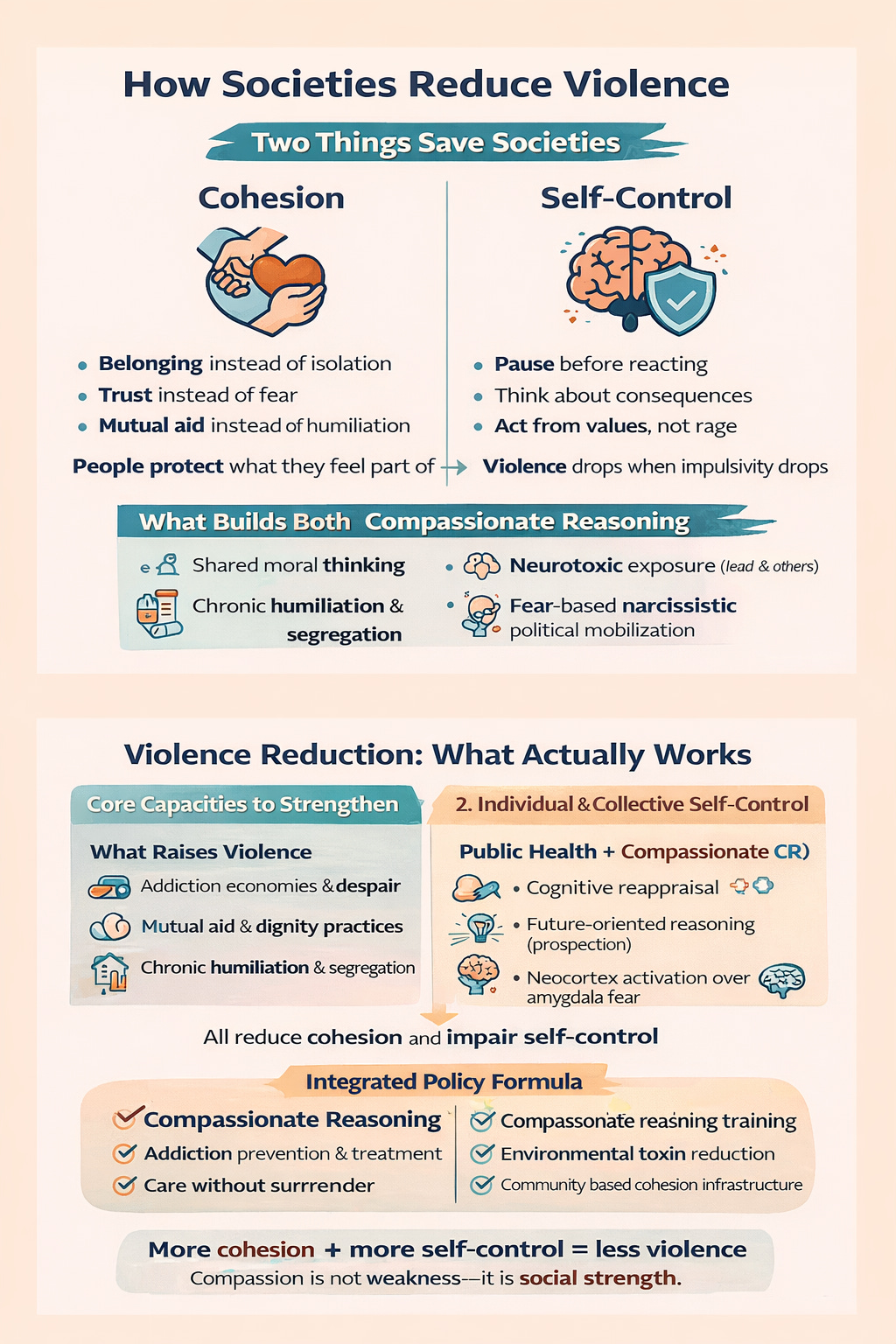
Across disciplines as varied as criminology, neuroscience, public health, and political psychology, the evidence converges on a striking conclusion: societies do not descend into violence primarily because of tools, ideologies, or even laws. They fracture when two human capacities erode—social cohesion and self-control. These are not abstract virtues or moral platitudes. They are trainable psychological and social capacities that operate simultaneously at individual, relational, and collective levels.
Cohesion reduces violence by shrinking the psychological distance between people. When individuals experience themselves as embedded in networks of mutual recognition, obligation, and care, fear loses its organizing power. Sociological research on “collective efficacy” shows that neighborhoods with strong relational ties and shared moral expectations experience dramatically lower rates of violence, independent of income or policing levels (Sampson, Raudenbush & Earls). Self-control reduces violence by widening the time horizon of decision-making—allowing people to pause, reflect, and choose responses aligned with long-term outcomes rather than immediate emotional discharge. Longitudinal studies tracking individuals from childhood to adulthood demonstrate that self-regulation predicts lower violence, better health, and greater civic stability decades later (Moffitt et al.).
What the data show, again and again, is that weapons availability alone cannot explain long-term patterns of homicide, particularly in the United States. Violence tracks far more closely with the weakening or strengthening of relational trust, emotional regulation, and future-oriented reasoning. This is precisely why I developed Compassionate Reasoning as an applied intervention methodology—not as a moral abstraction, but as a practical way to cultivate these two capacities under conditions of stress, conflict, and fear (Gopin, Compassionate Reasoning).
This perspective also clarifies why debates about guns so often miss the deeper drivers of violence. The decisive variable is not simply the presence or legality of firearms, but the presence—or absence—of cohesion and self-control. Where cohesion is strong and self-regulation is trained, even high-lethality tools are used with restraint, accountability, and moral seriousness. We see this in responsible hunting cultures, professional law enforcement units with strong ethical training, and communities governed by dense norms of mutual responsibility. Where cohesion fractures and self-control erodes—through addiction, chronic stress, humiliation narratives, or political fear-mongering—any weapon becomes dangerous. As Elijah Anderson showed decades ago, violence flourishes where people feel isolated, disrespected, and stripped of moral standing (Code of the Street).
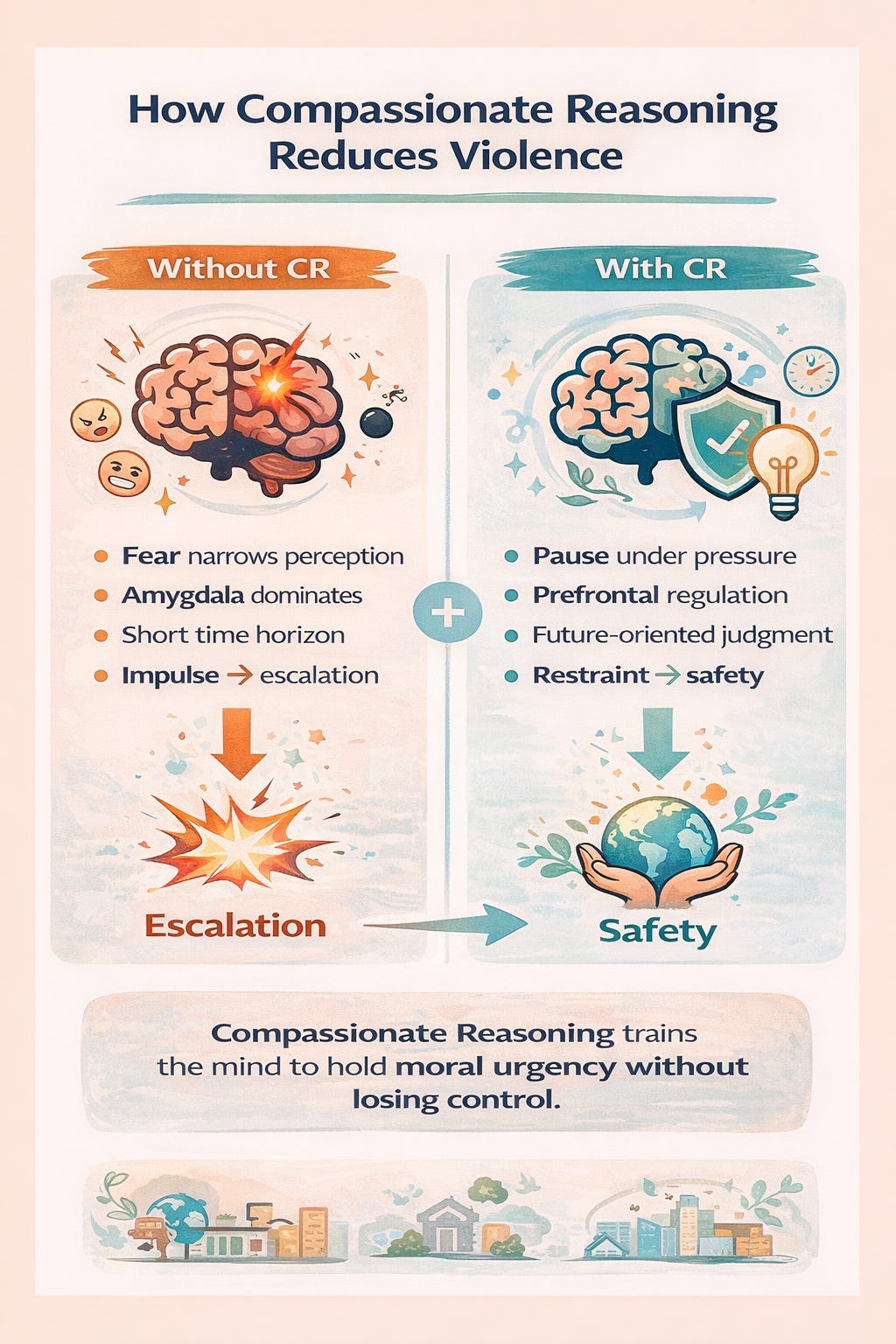
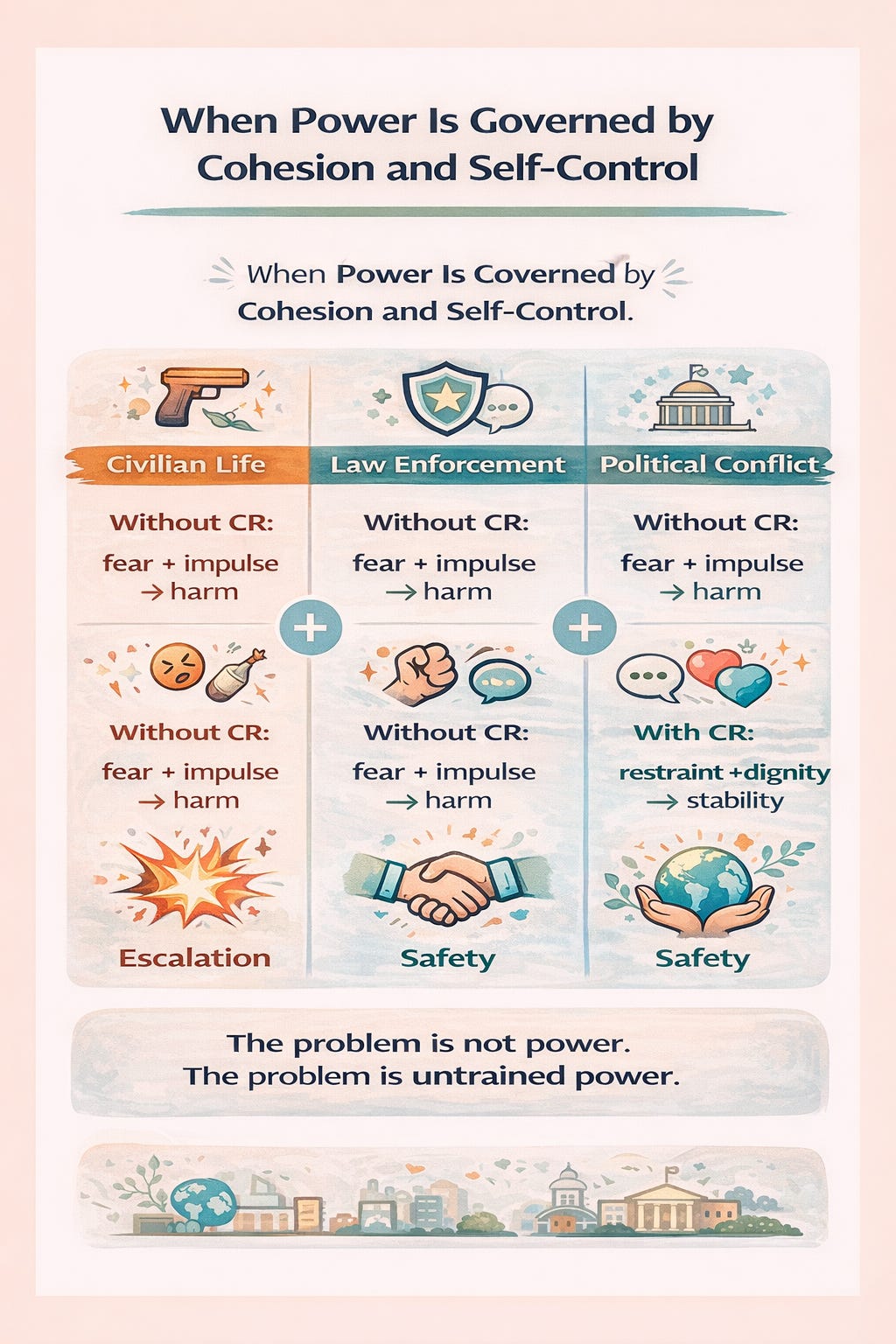
Compassionate Reasoning directly strengthens the capacities that differentiate responsible from irresponsible use of force. It trains pause under pressure, future-oriented judgment, emotional regulation, and dignity-preserving restraint. In this sense, Compassionate Reasoning is not peripheral to questions of public safety or gun violence; it addresses the human foundations of restraint itself. By increasing cohesion and strengthening self-control, it reduces the likelihood that fear, rage, or grievance will seize the moment of decision—whether in civilian life, law enforcement, or political conflict—and turn power into harm.
It stands to reason, then, that a flourishing and peaceful society rests on two reinforcing foundations. The first is deep social cohesion: not sameness or enforced agreement, but shared customs of compassionate care practiced across social, ethnic, religious, and political boundaries. The second is disciplined self-control: not repression, but the trained capacity for self-examination, moral reflection, and impulse regulation in moments of fear, anger, or humiliation. Societies that invest in both—cultivating compassionate cohesion while training the mind toward restraint and future-oriented judgment—dramatically reduce the conditions under which violence, scapegoating, and moral collapse take hold. Compassionate Reasoning brings these foundations together in a single applied framework (Gopin, Healing the Heart of Conflict).
How Compassionate Reasoning Builds Cohesion
Compassionate Reasoning strengthens cohesion not by demanding agreement, but by expanding shared moral space despite principled disagreement. It teaches people to reason together under serious moral tension—acknowledging difference while resisting humiliation, dehumanization, and domination. This distinction matters. Cohesion does not require sameness; it requires reliable moral presence across disagreement.
CR trains individuals and groups to cultivate compassion for themselves and others despite deep divides; to recognize identity threat without allowing it to consume engagement; to articulate moral convictions without collapsing into contempt; and to imagine futures that preserve the inherent value of all human life. Research on moral disengagement shows how easily cruelty becomes normalized when these capacities are absent (Bandura). CR interrupts that process by keeping moral attention alive under pressure.
At scale, these practices generate what sociologists describe as dense moral networks—webs of relationship where conflict does not immediately trigger withdrawal or aggression. Mutual aid, hospitality, and sustained cross-boundary engagement are not sentimental add-ons; they are mechanisms of social regulation that reduce anonymity, isolation, and fear. This is why societies with stronger social bonds consistently experience lower rates of violence (Sampson et al.). In this sense, Compassionate Reasoning functions as a cohesion technology, strengthening the connective tissue that allows societies to absorb stress without fracturing.
How Compassionate Reasoning Reduces Impulsivity
Equally important, Compassionate Reasoning directly targets impulsivity, a major driver of violence. From a neuropsychological perspective, CR shifts cognitive processing away from fear-dominated reactivity and toward reflective integration. Research on emotion regulation shows that practices such as cognitive reappraisal—reframing meaning under stress—activate prefrontal networks responsible for executive function and moral judgment, while dampening amygdala-driven threat responses (Gross; Ochsner & Gross).
Repeated compassionate practices—especially those involving self-care, imaginative perspective-taking, future visualization, and care-based action—strengthen neural pathways associated with emotional regulation, delayed gratification, and moral reasoning (Klimecki; Troy et al.). The result is not emotional suppression, but emotional containment: the capacity to feel moral urgency without losing control.
This is where Compassionate Reasoning aligns closely with positive psychology and prospection science. Human beings are future-oriented by nature; we are shaped by the futures we imagine (Seligman, Homo Prospectus). CR trains people to imagine futures that include others rather than eliminate them, which in turn stabilizes judgment in the present. Over time, this strengthens self-control not only in moments of conflict, but as a durable trait.
Mutual Aid, Compassion, and Cognitive Expansion
Mutual aid plays a distinctive role in this process. Acts of compassion—especially those that cross social or identity boundaries—are not only socially bonding; they are cognitively enlarging. They activate reward and trust systems in the brain while weakening the isolation–fear loop that fuels impulsive violence. People are far less likely to act impulsively when they feel seen, needed, and accountable to others.
Compassionate Reasoning amplifies this effect by giving people a shared language for understanding why restraint, dignity, and moral seriousness matter. Restraint becomes a form of strength, not weakness. Moral disagreement becomes survivable, not existential. This is how societies quietly increase self-control—not through punishment alone, but through belonging and meaning.
A Compassionate Reasoning Formula for Political Healing
Finally, this framework extends directly into political life. Political polarization and violence thrive on the same deficits: low cohesion and low self-control, amplified by narcissistic leadership, grievance narratives, and scapegoating. Such dynamics reward impulsivity—outrage, humiliation, domination—while eroding reflective judgment and shared reality.
Compassionate Reasoning offers a counter-formula for political healing: more cohesion across difference, less impulsivity in response to provocation, and greater resistance to narcissistic manipulation. By training citizens to recognize moral injury without weaponizing it, to hold conviction without contempt, and to imagine shared futures rather than zero-sum victories, CR undermines the psychological conditions on which polarizing leaders depend (Gopin, Bridges Across an Impossible Divide).
In this sense, Compassionate Reasoning is not only a method of violence reduction. It is a discipline of democratic resilience. Societies survive not merely by restraining weapons, but by cultivating the moral and neurological capacities that allow people to live together without fear ruling their choices.
Below are scenarios showing absence vs. full engagement of Compassionate Reasoning (CR).
Scenario: Weapons & Law Enforcement
A. Compassionate Reasoning Absent — Tragic Escalation
A patrol officer responds to a late-night disturbance call involving a man reportedly carrying a firearm. The officer arrives already primed by recent media coverage, fatigue, and a culture that equates hesitation with weakness. The civilian, visibly agitated and afraid, interprets the officer’s rigid posture and shouted commands as imminent threat. Both parties are operating from narrowed time horizons and fear-dominated perception. No one pauses to slow the interaction. No one signals dignity or shared humanity. A sudden movement—ambiguous but charged—triggers a reflexive response. Shots are fired. Within hours, the incident becomes a national flashpoint. Protests erupt. Trust collapses. The officer’s life is shattered; the civilian’s life is lost; the community fractures further. The weapon was present—but the deeper failure was the absence of cohesion and trained self-control at the moment of decision.
B. Compassionate Reasoning Fully Engaged — Stabilization and Restraint
In a similar call, the officer has been trained in Compassionate Reasoning as part of professional formation—not as softness, but as discipline. Upon arrival, the officer consciously slows breathing, modulates tone, and uses language designed to widen the interaction rather than dominate it. The officer names the tension without humiliation: “I see you’re upset. My job is to keep everyone safe—including you.” Clear boundaries are set, but dignity is preserved. The civilian, sensing recognition rather than threat, gradually de-escalates. Time horizons widen. The weapon is secured without force. No one is harmed. The encounter ends without viral footage or national outrage—precisely because fear never seized control of the moment. Here, CR did not remove the weapon; it governed the human use of power surrounding it.
Scenario: Political Divide — School Curriculum
A. Compassionate Reasoning Absent — Polarization and Damage
A school board meeting on curriculum becomes a moral battleground. Parents arrive primed by social media outrage and partisan framing. Each side views the other as existentially dangerous. Speakers are interrupted, mocked, or shouted down. Humiliation replaces listening. Threats follow. Teachers leave the profession. Students absorb the lesson that power comes from domination, not care. The community fractures into camps that no longer recognize one another as moral actors. Policy outcomes are imposed through exhaustion and fear, leaving lasting resentment and civic damage.
B. Compassionate Reasoning Fully Engaged — Durable Disagreement with Dignity
In another district, the same issue arises—but CR principles are explicitly embedded in the process. Participants are trained to articulate convictions without contempt and to recognize identity threat without weaponizing it. Meetings begin with shared commitments: the infinite value of children, the role of education in forming citizens, and the legitimacy of moral disagreement. Facilitated CR practices encourage future-oriented reasoning: What kind of community do we want our children to inherit? Agreement is not guaranteed—and does not occur on most points—but violence and humiliation are absent. Compromises emerge where possible; principled disagreement remains where necessary. Trust survives the conflict. The system holds.
The Contrast That Matters
Where cohesion and self-control are depressed, where Compassionate Reasoning is absent, fear accelerates, impulsivity dominates, and power—whether a weapon or a political majority—turns destructive. Where Compassionate Reasoning is practiced, cohesion expands and self-control governs action. Violence becomes less likely not because conflict disappears, but because human beings remain capable of restraint, imagination, and moral presence under pressure.
This is the deeper lesson: tools do not determine outcomes—trained human capacities do. Compassionate Reasoning is not an add-on to safety, policing, or democracy. It is the discipline that allows power to be exercised without destroying the very society it is meant to protect. Here are a few illustrations to concretize the arguments.
Conclusion: Training the Human Capacities That Make Peace Durable
The evidence, the theory, and the scenarios converge on a single, sobering insight: societies do not fail primarily because they lack laws, weapons regulations, or political arguments. They fail when the human capacities required to live with power, disagreement, and fear are left untrained. Cohesion and self-control are not sentimental ideals; they are the operating system of a peaceful society. When they erode, no policy can fully compensate. When they are cultivated, even high-risk tools and deep moral conflict can be navigated without collapse.
The paired scenarios—whether involving firearms, law enforcement encounters, or moral conflict over school curriculum—make this visible in human terms. The same tools, the same conflicts, and the same legal frameworks lead to radically different outcomes depending on whether people are operating from fear and impulse or from trained restraint and shared moral presence. Violence is not inevitable in moments of tension; it is chosen—or prevented—at the point where fear either overwhelms judgment or is held within it.
This is why Compassionate Reasoning matters. It is not a call to agree, to soften convictions, or to retreat from conflict. It is a discipline for remaining fully moral, fully accountable, and fully human under pressure. By strengthening cohesion, it rebuilds the relational fabric that makes restraint meaningful rather than lonely. By strengthening self-control, it restores the neurological and moral capacity to pause, imagine consequences, and choose wisely even when stakes are high. Together, these capacities turn power from a liability into a responsibility.
The illustrative framework—Cohesion + Self-Control → Violence Reduction, Democratic Stability, and Moral Resilience—is not merely conceptual. It is practical, trainable, and scalable. It applies to policing and civilian life, to political struggle and civic disagreement, to classrooms, communities, and nations under strain. Where Compassionate Reasoning is practiced, fear loses its monopoly on decision-making. Where it is absent, fear governs quickly and destructively.
In the end, the question before us is not whether societies will face conflict—they always will. The question is whether we will invest seriously in the human capacities that allow conflict to be carried without turning into catastrophe. Compassionate Reasoning offers a way forward that neither denies moral difference nor surrenders to it. It teaches societies how to argue without dehumanizing, to wield power without destroying trust, and to remain future-oriented even when the present is charged with fear.
Peace, in this sense, is not an accident or a pause between crises. It is a learned achievement—one built from thousands of moments in which cohesion holds and self-control governs. When those capacities are widely trained, peace stops being fragile. It becomes durable, shared, and worthy of the name.
References
Anderson, Elijah. Code of the Street: Decency, Violence, and the Moral Life of the Inner City. New York: W. W. Norton, 1999.
Bandura, Albert. “Moral Disengagement in the Perpetration of Inhumanities.” Personality and Social Psychology Review 3, no. 3 (1999): 193–209.
Blair, R. J. R. “The Neurobiology of Psychopathic Traits in Youth.” Nature Reviews Neuroscience 14, no. 11 (2013): 786–799.
Gross, James J. “The Emerging Field of Emotion Regulation: An Integrative Review.” Review of General Psychology 2, no. 3 (1998): 271–299.
Gross, James J., and Oliver P. John. “Individual Differences in Two Emotion Regulation Processes: Implications for Affect, Relationships, and Well-Being.” Journal of Personality and Social Psychology 85, no. 2 (2003): 348–362.
Klimecki, Olga M. “The Role of Empathy and Compassion in Conflict Resolution.” Emotion Review 11, no. 4 (2019): 310–325.
Moffitt, Terrie E., et al. “A Gradient of Childhood Self-Control Predicts Health, Wealth, and Public Safety.” Proceedings of the National Academy of Sciences 108, no. 7 (2011): 2693–2698.
Ochsner, Kevin N., and James J. Gross. “The Cognitive Control of Emotion.” Trends in Cognitive Sciences 9, no. 5 (2005): 242–249.
Sampson, Robert J., Stephen W. Raudenbush, and Felton Earls. “Neighborhoods and Violent Crime: A Multilevel Study of Collective Efficacy.” Science 277, no. 5328 (1997): 918–924.
Seligman, Martin E. P. Homo Prospectus. Oxford: Oxford University Press, 2018.
Troy, Allison S., et al. “Cognitive Reappraisal and Stress Resilience.” Journal of Personality and Social Psychology 104, no. 2 (2013): 304–317.
Wilson, James Q., and George L. Kelling. “Broken Windows.” The Atlantic, March 1982.
(Note: Later research complicates this model; cohesion-based findings revise its conclusions.)
Marc Gopin (Primary Framework)
Gopin, Marc. Compassionate Reasoning: The Science and Ethics of Moral Action. Oxford: Oxford University Press, 2022.
Gopin, Marc. Healing the Heart of Conflict: Eight Crucial Skills for Peacemaking in Times of Crisis. Emmaus, PA: Rodale Press, 2016.
Gopin, Marc. Bridges Across an Impossible Divide: The Inner Lives of Arab and Jewish Peacemakers. Oxford: Oxford University Press, 2020.