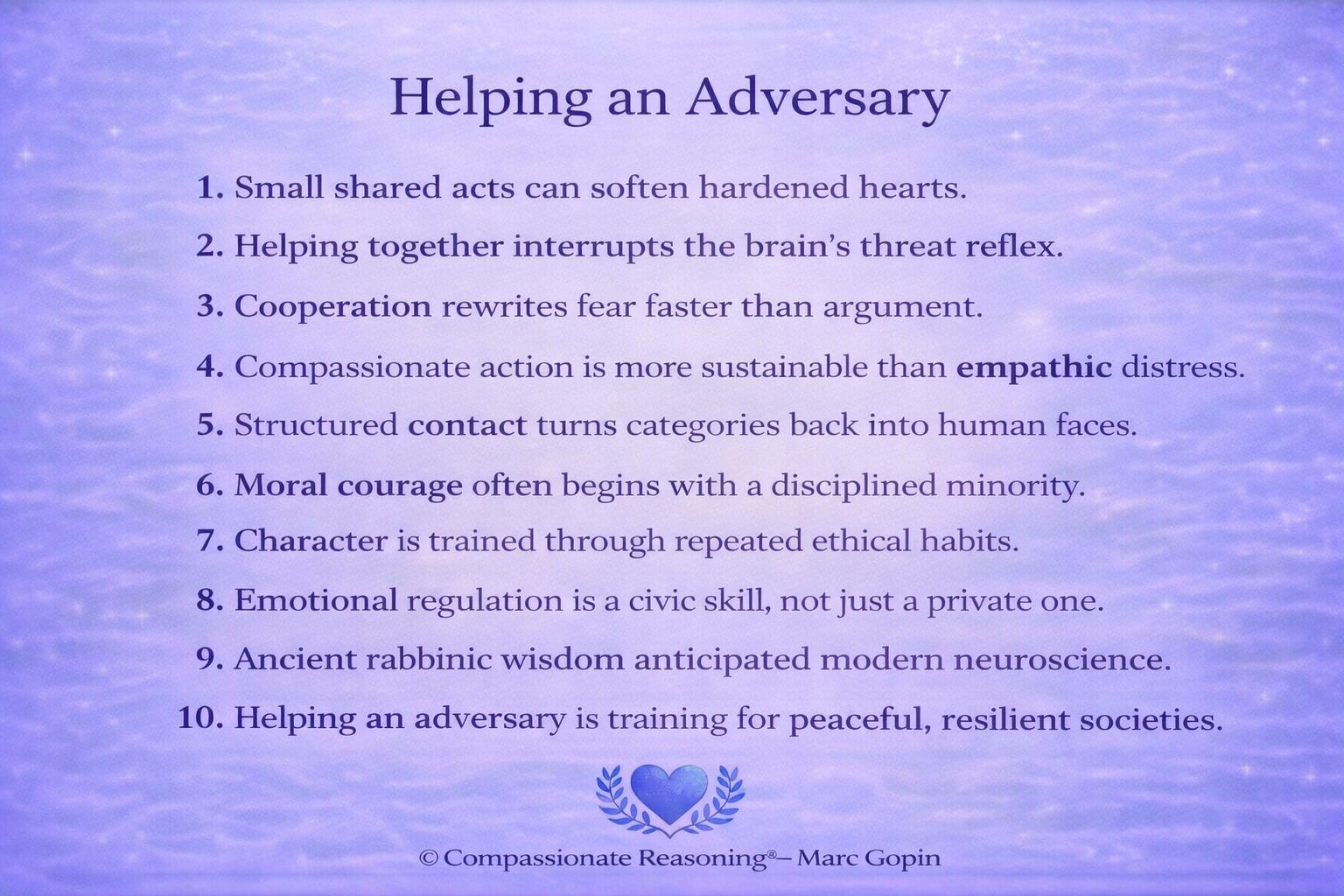
Helping an Adversary:
Ancient Wisdom Confirmed by Neuroscience

For decades, I have worked with people living inside bitter conflict, and one pattern has repeated itself with a consistency that still surprises me. We have story after story of adversaries who helped each other in times of desperate need, and in so doing turned their bitter relationship around. Their gestures did not erase history, nor did they instantly produce trust, but they softened certainty. The other person became less of an abstraction and more of a human being with a task to complete beside you. This phenomenon appears so regularly in documented interfaith and conflict-resolution work—described in studies such as Peacemakers in Action, the Johnston diplomacy volumes, and my own books—that it demands explanation.
A short instruction in the Hebrew Bible, over 2500 years old, captures this insight with extraordinary clarity. Here it is, in a deceptively simple, stark refrain in Exodus 23: If you encounter the lost animal of someone who opposes you, you must return it; if you see an adversary suffering under a burden, you must help together with them. Ancient rabbinic commentators—especially in the Talmud and later ethical commentaries (e.g., Bava Metzia 32b; Mechilta, Mishpatim 18; Rashi; Ramban; Sefer HaChinukh)—suggested that this command was designed to subdue destructive impulses, remove hatred from the heart, and restore social trust. These commentators were not offering abstract spirituality but rather were describing a disciplined behavioral intervention into human psychology. Contemporary neuroscience now provides us with the language to understand why this ancient intuition works.
The Brain Is Built for Threat, Not Immediately for Reconciliation
When we categorize someone as an adversary, the brain reacts automatically. The amygdala and related limbic systems assign salience and potential threat long before conscious reasoning takes place. This rapid tagging process is adaptive for survival, but disastrous for social peace. Once a person is encoded as dangerous, memory retrieval becomes selective, attention narrows, and the mind constructs narratives that confirm terror. These processes are largely automatic and emotionally charged, and they cannot be corrected by moral argument alone.
Research on emotion regulation shows that changing such responses requires interaction between limbic systems and prefrontal networks that support reappraisal, inhibition of impulsive reactions, and flexible reasoning. The prefrontal cortex can gradually reduce amygdala reactivity, but it requires repeated experiences that contradict threat predictions. In moral language, ancient rabbinic commentators spoke of conquering destructive impulses. Neuroscientific language speaks of top-down regulation of limbic reactivity. Both descriptions recognize that ethical development depends on disciplined action under emotional pressure.
Helping an adversary is therefore not only an act of emotional generosity, though that alone would be laudable and even saintly. More practically, however, helping an adversary is a carefully structured interruption of a neural reflex.
Why Shared Action Changes Emotional Reality
The rabbinic insistence that the Hebrew phrasing suggests that help be given with the adversary is psychologically profound. Cooperation in a shared task creates synchrony of attention, predictability of behavior, and mutual dependence. These are precisely the conditions that allow the brain to update threat predictions. Instead of confirming hostility, the interaction produces a corrective experience: the anticipated harm does not occur, coordination succeeds, and the adversary behaves like a partner in a joint task.
Neuroscience understands emotional learning as a process of grappling with prediction. When a feared outcome repeatedly fails to occur, the brain revises its model. Cooperative interaction, therefore, weakens automatic threat perceptions and strengthens trust pathways instead. What ancient rabbinic commentators described as “removing hatred from the heart” corresponds to scientifically measurable changes in emotional processing.
Importantly, this process does not require agreement about the history of the fighting or ideological frames of just warfare. All it requires is a shared responsibility in the present. That is why even small acts of cooperation have disproportionate emotional effects.
Compassion Without Emotional Overload
Another lesson from conflict work is that empathy with pain alone is not enough. When people simply absorb one another’s pain, they often become overwhelmed, angry, or exhausted. Contemporary neuroscience distinguishes empathic distress from compassion. Research by Klimecki, Singer, and colleagues shows that empathic distress activates networks associated with negative affect, whereas compassion training recruits circuits linked to motivation, resilience, and prosocial care. Compassion is, therefore, more sustainable than raw empathy.
Ancient rabbinic texts implicitly understood this distinction by not requiring emotional intimacy with an adversary. They required a limited act of help instead. That discreet action channels moral energy into constructive behavior without emotional flooding that can overwhelm. It allows compassion to grow through action rather than through overwhelming feelings that can backlash into older hatreds. This insight is deeply consistent with modern findings about the neural basis of prosocial motivation.
From Categories to Persons
In prolonged conflicts, people stop seeing individuals and begin seeing categories, as labels replace faces, fear becomes generalized, and moral certainty becomes absolute. Social neuroscience shows that structured intergroup contact—especially cooperative contact—reduces prejudice and anxiety by forcing individuation. The brain begins to encode specific people, seeing real people in all their humanity rather than abstract threats.
The ancient instruction about returning a lost animal or helping lift a burden functions precisely this way. It compels two adversaries into a shared moral project that is small enough to be possible but meaningful enough to matter. That experience plants doubt in the inevitability of hatred, and doubt, the commentators argue wisely, is the beginning of peace.
Doubt is the beginning of peace.
The Crowd, the Leader, and the Moral Minority
There is another dimension we must confront honestly. Human beings are profoundly susceptible to collective anger. Fear and humiliation spread quickly through groups, and leaders who manipulate resentment can mobilize large populations into obedience and cruelty. The neuroscience of social conformity shows that belonging to a group can override individual moral hesitation, because social approval and fear of exclusion activate powerful emotional circuits.
History, therefore, reminds us that the majority is often swept into anger, while leadership emerges from a few who resist. In complex social systems, small numbers of disciplined actors can exert disproportionate influence. When a minority models restraint, courage, and compassionate action, they change what appears normal. Social learning spreads through imitation, emotional contagion, and narrative, as a few people who refuse hatred can alter the trajectory of a community.
Helping an adversary is thus not merely a matter of interpersonal ethics; it is civic leadership training. Helping an adversary prepares individuals to resist the pull of mob anger and to create alternative emotional norms.
Moral Training as Neural Training
Ancient rabbinic commentators believed that character is shaped by repeated action, while neuroscience confirms that habits alter neural pathways. Each cooperative act strengthens networks associated with self-regulation and prosocial motivation, while each safe interaction weakens reflexive hostility. Over time, the brain becomes better at reasoning in the presence of fear.
What ancient rabbinic commentators observed through moral reflection, neuroscience now explains through brain systems. The insight of the ancients was not naïve, it turns out, but rather it was empirically grounded in long observation of human behavior.
Why This Matters Now
We live in an era of algorithmic outrage, political tribalism, and emotional manipulation. We are encouraged to argue louder, condemn faster, and divide more sharply. Ancient biblical and rabbinic wisdom suggests something quieter and more radical: help an adversary in something concrete and limited. Do one thing together that reduces suffering.
Such acts will not solve every conflict. But they change the emotional climate in ways that make reasoning possible. They recalibrate threat perception, strengthen compassion, and create conditions for trust to grow.
Across cultures and centuries, thoughtful observers discovered that hatred is rarely argued away. It is more often dissolved through disciplined acts of care. When two people lift a burden together, something shifts—in memory, in emotion, in expectation. The adversary becomes human again, friendship emerges, and humanity’s hope is restored. Whether this becomes viral and inspires the mob to change course depends on many shifting factors beyond individuals’ control in the moment, but the moment of help becomes a permanent marker of heroic courage, undeniable compassion, hopeful possibility, and faith in the future.
Reference List
I. Primary Rabbinic Sources on Helping an Adversary
Babylonian Talmud. Bava Metzia 32b.
Mechilta de-Rabbi Ishmael. Mishpatim, parasha 18.
Rashi (Rabbi Shlomo Yitzchaki). Commentary on Exodus 23:4–5.
Nachmanides (Ramban). Commentary on Exodus 23:4–5.
Sefer HaChinukh. Commandment 80.
Maimonides (Rambam). Mishneh Torah, Hilkhot Rotzeach u-Shemirat HaNefesh 13:9–13.
II. Conflict-Resolution Case Studies Referenced
Tanenbaum Center Volumes
Dubensky, Joyce S., ed. Peacemakers in Action: Profiles of Religion in Conflict Resolution. Cambridge University Press, 2006.
Dubensky, Joyce S., ed. Peacemakers in Action: Profiles in Religious Peacebuilding, Volume II. Cambridge University Press, 2016.
Douglas Johnston Edited Volumes
Johnston, Douglas, and Cynthia Sampson, eds. Religion, the Missing Dimension of Statecraft. Oxford University Press, 1994.
Johnston, Douglas, ed. Faith-Based Diplomacy: Trumping Realpolitik. Oxford University Press, 2003.
III. Marc Gopin — Relevant Works
Gopin, Marc. Between Eden and Armageddon: The Future of World Religions, Violence, and Peacemaking. Oxford University Press, 2000.
Gopin, Marc. Holy War, Holy Peace: How Religion Can Bring Peace to the Middle East. Oxford University Press, 2002.
Gopin, Marc. To Make the Earth Whole: The Art of Citizen Diplomacy in an Age of Religious Militancy. Rowman & Littlefield, 2010.
Gopin, Marc. Healing the Heart of Conflict. Rodale Books, 2016.
✅ Gopin, Marc. Bridges Across an Impossible Divide: The Inner Lives of Arab and Jewish Peacemakers. Oxford University Press, 2020.
Gopin, Marc. Compassionate Reasoning: Changing the Mind to Change the World. Oxford University Press, 2024.
IV. Neuroscience of Emotion Regulation
Ochsner, Kevin N., and James J. Gross. “The Cognitive Control of Emotion.” Trends in Cognitive Sciences 9 (2005): 242–249.
Etkin, Amit, Tobias Egner, and Raffael Kalisch. “The Neural Bases of Emotion Regulation.” Nature Reviews Neuroscience 16 (2015): 693–700.
Buhle, Jason T., et al. “Cognitive Reappraisal of Emotion.” Social Cognitive and Affective Neuroscience 9 (2014): 1955–1962.
Arnsten, Amy F. T. “Stress Signalling Pathways That Impair Prefrontal Cortex Function.” Nature Reviews Neuroscience 10 (2009): 410–422.
V. Compassion vs Empathic Distress
Klimecki, Olga M., Silke Leiberg, Claus Lamm, and Tania Singer. “Functional Neural Plasticity After Compassion Training.” Cerebral Cortex 24 (2014): 1662–1671.
Singer, Tania, and Olga M. Klimecki. “Empathy and Compassion.” Current Biology 24 (2014): R875–R878.
Gilbert, Paul. The Compassionate Mind. London: Constable & Robinson, 2009.
VI. Intergroup Contact Research
Pettigrew, Thomas F., and Linda R. Tropp. “A Meta-Analytic Test of Intergroup Contact Theory.” Journal of Personality and Social Psychology 90 (2006): 751–783.
Allport, Gordon. The Nature of Prejudice. Addison-Wesley, 1954.
VII. Integrative Complexity Research
Tetlock, Philip E. “Cognitive Style and Political Belief Systems.” Journal of Personality and Social Psychology 46 (1984): 365–375.
Suedfeld, Peter, Karen Guttieri, and Philip E. Tetlock. “Assessing Integrative Complexity at a Distance.” Political Psychology 24 (2003): 529–543.