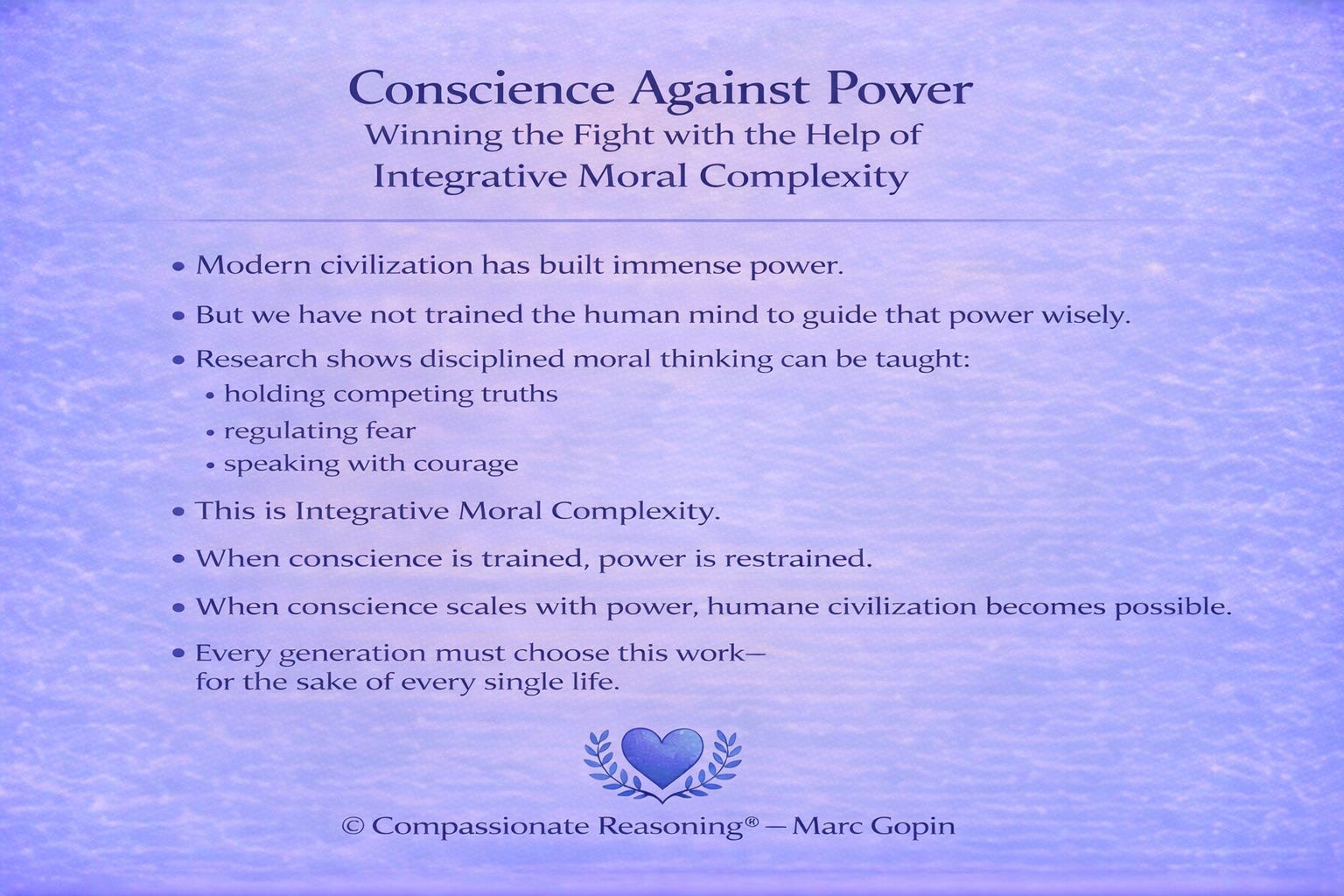
Conscience Against Power
Winning the Fight with the Help of Integrative Moral Complexity

INTRODUCTION
Modern civilization has achieved an unprecedented asymmetry. We have built systems of extraordinary technological, bureaucratic, military, and informational power—yet we have not built a parallel system to cultivate the human capacities required to guide that power responsibly, or to resist it when it is misused. The result is not merely ethical fragility but structural instability. When enormous power is placed in human hands without training in disciplined moral judgment, even decent societies can become dangerous to themselves.
This essay advances a single claim: societies must deliberately cultivate the capacity to think clearly and act ethically under pressure. Research across political psychology, neuroscience, organizational behavior, and education shows that the ability to recognize competing values, regulate emotion, and speak up responsibly can be strengthened through training across the lifespan. Without that preparation, stress and authority pressures narrow judgment, and people cooperate in harm they would otherwise reject.
I draw on the well-established concept in brain research of integrative complexity—the cognitive capacity to recognize multiple legitimate perspectives and integrate them into coherent judgment. I then extend it into the ethical domain through what I call Integrative Moral Complexity: the disciplined application of integrative thinking to real moral choices, supported by emotional regulation, institutional protection for dissent, and lifelong practice. I argue that this capacity is essential for human beings at every level of education and income. It is part of the stabilizing architecture of humane civilization.
When that architecture weakens—through extreme inequality, manufactured fear, humiliation, scapegoating, or authoritarian pressure—institutions drift toward simplification, dehumanization, and escalation. But when people learn to hold complexity, regulate emotion, and distinguish legitimate authority from harmful orders, societies gain resilience.
This is not an argument for ideological conformity. It is an argument for strengthening the habits of moral reasoning themselves—so that cooperation remains principled, dissent remains responsible, and power remains culturally bound by conscience.
EXECUTIVE SUMMARY
Research in political psychology shows that leaders and citizens who can recognize multiple legitimate perspectives and integrate them into coherent judgment are less likely to escalate conflict. Neuroscience shows that acute stress narrows this capacity, but emotional regulation can help preserve it. Educational research demonstrates that peer cruelty and bystander inaction can be reduced through structured training. Organizational research shows that people are more likely to speak up about danger or wrongdoing when institutions protect and encourage them. Together, these findings point to a practical conclusion: ethical judgment under pressure is not simply a matter of spontaneous virtue. It is a capacity that can be cultivated.
Modern societies train citizens in literacy, professional competence, and emergency response. Yet we rarely train people to distinguish legitimate authority from harmful orders, to resist peer pressure constructively, or to weigh competing values when fear and loyalty collide. As our systems grow more powerful, this gap becomes dangerous.
Civilization does not depend on universal heroism. It depends on enough people, at critical moments, having the clarity and courage to resist dehumanization and prevent cascades of harm. Small increases in such behavior can dramatically alter outcomes. Compassion-based emotional regulation and disciplined reasoning offer practical tools for strengthening these capacities. A society that cultivates them deliberately becomes harder to radicalize, harder to polarize, and better able to solve problems without violence.
The goal of this essay is therefore simple: to show that integrative thinking applied to moral life—what I call Integrative Moral Complexity—should become an essential part of civic education, professional training, and democratic culture if humane civilization is to remain stable in an age of unprecedented power.
I. The Asymmetry of Power and Preparation
Modern civilization has constructed an extraordinary apparatus of technical and institutional power while neglecting the systematic cultivation of moral capacity required to wield it responsibly. Children are trained in literacy, numeracy, and technological fluency. Professionals rehearse crisis simulations; pilots train for emergencies; surgeons practice contingencies. Competence in these domains is treated as infrastructure—predictable, measurable, continuously reinforced.
In contrast, moral emergencies are left to improvisation. A moral emergency occurs whenever an individual is pressured—by peers, authority, ideology, or fear—to participate in harm, humiliation, or dehumanization. Such situations arise on playgrounds, in classrooms, in hospitals, in police units, in corporate hierarchies, and within political movements. Despite their frequency and consequences, societies do not systematically rehearse how to respond to them.
Decades of social-psychological and historical evidence suggest that conscience alone is not enough under pressure. Authority cues, conformity pressures, and fear can override moral hesitation in predictable ways. This is not a speculative claim but a widely documented pattern in political psychology and behavioral research (Tetlock 1984; Suedfeld, Guttieri, and Tetlock 2003).
The imbalance between expanding power and stagnant moral preparation creates a structural asymmetry. As technological and bureaucratic capacity increases, the consequences of moral failure scale correspondingly. Systems capable of immense coordination are operated by individuals whose preparation for resisting wrongful pressure remains uneven and informal. This asymmetry is not philosophical rhetoric; it is a measurable vulnerability.
II. Moral Collapse Is Common—and Conditional
Research in social psychology and political behavior shows that moral collapse under structured pressure is not rare. Individuals placed in hierarchical environments that legitimize harmful action frequently comply even when visibly distressed. Authority cues, belonging incentives, and ideological framing can override moral hesitation. People often rationalize participation in harm as duty, necessity, or protection of a greater good.
At the same time, dissenters exist in every system—whistleblowers, rescuers, professionals who refuse unlawful orders. Their presence shows that moral capacity does not disappear under pressure; rather, it is inconsistently activated. The difference between compliance and refusal involves emotional regulation, prior rehearsal of dissent, moral identity, and institutional protection.
Organizational research shows that people speak up more when authority gradients are flattened and psychological safety is reinforced (Edmondson 1999). High-reliability industries such as aviation institutionalized this lesson through Crew Resource Management training, after accident investigations showed that co-pilots often failed to challenge dangerous decisions (FAA CRM training materials).
Educational research shows similar patterns. Structured anti-bullying and social-emotional learning programs measurably reduce cruelty and increase prosocial behavior (Durlak et al. 2011; Gaffney et al. 2019). These findings demonstrate something hopeful and practical: moral behavior is probabilistic, not fixed. And probabilities can be shifted.
III. Integrative Complexity Under Stress
Integrative complexity refers to the ability to recognize multiple legitimate perspectives and integrate them into a coherent judgment. Leaders and citizens who demonstrate this capacity are more likely to navigate crises without escalating into binary thinking or authoritarian simplification (Tetlock 1984; Suedfeld et al. 2003).
But neuroscience shows why this capacity is fragile. Acute stress impairs executive functioning and cognitive flexibility—the very capacities required for integrative thinking (Arnsten 2009; Shields et al. 2016; Starcke and Brand 2012). When stress hormones rise, neural resources shift toward threat detection and rapid reaction systems. Even decent people begin to think in rigid ways.
Modern brain research confirms that complex reasoning depends on coordination among distributed neural networks—frontoparietal control systems, default-mode integration systems, and salience networks that switch attention (Marek and Dosenbach 2018; Menon and Uddin 2010; Andrews-Hanna et al. 2014; Spreng et al. 2013). Under stress, connectivity across these networks decreases, narrowing cognitive flexibility.
Political psychology shows parallel patterns in public language. Leaders’ rhetoric becomes measurably more simplistic during crises, correlating with escalatory policy choices (Suedfeld et al. 2003). These findings converge on a single insight: integrative reasoning is real, measurable, fragile under stress, but trainable.
Research on mindfulness, dialogical education, and compassion-based training shows measurable changes in neural connectivity and emotional regulation that support flexible cognition (Klimecki et al. 2014; Taren et al. 2015). Integrative complexity is not fixed, and it can be cultivated.
IV. Disciplined Judgment: Distinguishing Authority from Harm
A society that trains only in obedience guarantees complicity in injustice, but one that trains only in defiance risks chaos. What is needed is disciplined judgment—the capacity to distinguish legitimate authority from illegitimate harm. Integrative complexity allows individuals to weigh these tensions without collapsing into simplistic thinking.
High-reliability industries demonstrate this principle in practice. Crew Resource Management in aviation and TeamSTEPPS in healthcare show that structured communication training improves safety outcomes by empowering professionals to challenge dangerous decisions (FAA CRM; AHRQ TeamSTEPPS). Amy Edmondson’s research on psychological safety shows that teams with protected voice detect errors earlier and perform better over time (Edmondson 1999). Institutional protection for conscience is not optional; it is causal.
Disciplined judgment transforms dissent from impulsive rebellion into responsible action and transforms cooperation from blind loyalty into principled collaboration. This is the civic meaning of integrative moral complexity: the trained ability to hold competing values long enough to act wisely.
V. Childhood Moral Rehearsal
Developmental psychology shows that peer cruelty and bystander behavior are not fixed traits but are shaped by the environment and training. Large meta-analyses of school-based social-emotional learning and anti-bullying programs show measurable reductions in both aggression and victimization when structured interventions are implemented (Durlak et al. 2011; Gaffney et al. 2019).
Children learn scripts through repetition and modeling. When refusal and defense of others are practiced aloud and reinforced publicly, those responses become neurologically and socially permissible. Early training can include simple distinctions—between harm and annoyance, joking and humiliation, authority and coercion.
These programs do not produce moral perfection, but they do shift probabilities. They show that the capacity to resist cruelty can be strengthened long before adulthood. The most important civic lesson is that conscience is teachable.
VI. Adolescence, Identity, and Regulation
Adolescence is a period of heightened sensitivity to peer evaluation and social ranking. Social neuroscience shows increased activation in brain regions related to reward and threat during adolescence, which intensifies conformity pressures (Blakemore and Mills 2014; Somerville 2013).
Digital amplification has made these pressures even stronger. Yet adolescence is also a window of plasticity. Programs that teach emotional regulation, bystander intervention, and social-emotional learning show measurable improvements in impulse control and reductions in aggression (Durlak et al. 2011). Mindfulness-based interventions, dialogical learning, and compassion-focused training have also been associated with improved emotional regulation and cognitive flexibility (Klimecki et al. 2014). This period is therefore not merely a risk stage but an opportunity. If adolescents learn how to regulate fear, tolerate disagreement, and speak responsibly under pressure, those habits carry into adult civic life.
VII. Professional Hierarchies and Speaking Up
The cultivation of conscience must continue throughout adult professional life. Research in aviation revealed that many accidents were caused not by technical failure but by silence. Co-pilots often noticed danger but did not challenge the captains. Crew Resource Management training was introduced to flatten authority gradients and teach structured communication. Aviation safety improved dramatically after these reforms (FAA Crew Resource Management materials).
Healthcare followed with TeamSTEPPS, an evidence-based teamwork framework that trains professionals to raise concerns clearly and escalate appropriately. Evaluations report improved perceptions of teamwork and safety climate after implementation (AHRQ TeamSTEPPS curriculum).
Amy Edmondson’s work on psychological safety confirms the pattern. Teams where members feel safe to raise concerns show more learning behavior and better error detection (Edmondson 1999). These findings are practical and profound. Speaking up is not merely a personality trait. It is shaped by training, institutional culture, and protection from retaliation. Conscience, again, is teachable.
VIII. Lifelong Practice and Civic Culture
The cultivation of conscience must continue throughout adult professional life. Research in aviation revealed that many accidents involved failures of communication and authority gradients inside the cockpit. Crew Resource Management training was introduced to flatten those hierarchies and teach structured communication among crew members (FAA 2004).Crew Resource Management has since become standard practice across aviation and is widely credited with improving safety culture and teamwork in flight operations (FAA 2004).
Healthcare followed with TeamSTEPPS, an evidence-based teamwork framework derived from aviation training that teaches professionals to raise concerns clearly and escalate appropriately. Evaluations report improved perceptions of teamwork and safety climate after implementation (AHRQ 2019).
Amy Edmondson’s work on psychological safety confirms the pattern. Teams in which members feel safe to raise concerns exhibit greater learning behavior and better error detection (Edmondson 1999). These findings are practical and profound. Speaking up is not merely a personality trait. It is shaped by training, institutional culture, and protection from retaliation. Conscience, again, is teachable. The skills of speaking up must become essential to civil society and professional success because it is at the core of society’s commitment to honesty and to saving lives.
IX. Political Leadership and Democratic Stability
Training in disciplined judgment must extend into civic life and leadership evaluation. Comparative political research shows recurring warning signs of democratic erosion: dehumanizing rhetoric, delegitimization of institutions, and framing opponents as existential enemies. These patterns are associated with democratic backsliding across different political systems (Levitsky and Ziblatt 2018; Müller 2016; Guriev and Treisman 2022).
When public discourse narrows into binary loyalty tests, citizens lose the ability to weigh competing goods. Leaders who reward conformity over competence or demonize dissent weaken institutional resilience. Political psychology research shows that leaders’ language often becomes measurably more simplistic during escalating crises, correlating with rigid policy positions (Suedfeld, Guttieri, and Tetlock 2003).
A morally prepared electorate, therefore, should evaluate leadership not only by policy promises but by demonstrated reasoning under pressure—emotional regulation, respect for institutional limits, and tolerance of dissent. Democracy depends not only on rules, but on habits of judgment.
X. Emotional Regulation as Civic Infrastructure
Resistance to harmful pressure requires tolerating anxiety, ambiguity, and social risk. Compliance often offers immediate emotional relief. Emotional regulation allows individuals to endure discomfort without collapsing into silence or aggression.
Neuroscience research shows that acute stress impairs executive functioning and cognitive flexibility (Arnsten 2009; Shields et al. 2016). Emotion regulation is therefore not peripheral to reasoning—it is a condition for it. Research on compassion training and mindfulness shows measurable effects on emotional regulation and neural connectivity associated with flexible cognition (Klimecki et al. 2014; Taren et al. 2015). Organizational research shows that psychological safety—protected emotional space for speaking up—improves learning and error detection (Edmondson 1999).
These findings converge on a simple lesson: emotional stability supports moral clarity. Training in regulation is not therapy alone. It is civic preparation.
XI. Civilization as Probability Management
Civilization does not depend on universal heroism. It depends on sufficient resistance to prevent cascades of harm. Organizational research shows that small increases in speaking up behavior dramatically improve safety outcomes in high-risk environments (Edmondson, 1999; FAA Crew Resource Management materials). Anti-bullying and social-emotional learning programs show measurable shifts in peer behavior when structured training is implemented (Durlak et al. 2011; Gaffney et al. 2019).
Political psychology similarly shows that leadership reasoning style correlates with escalation patterns during crises (Tetlock 1984; Suedfeld et al. 2003). These findings suggest that moral behavior at scale changes the probabilities enough to make historic shifts in better directions. Small increases in refusal rates, protected dissent, and disciplined reasoning can alter institutional trajectories. Civilization is, in practice, a problem of probability management that modest shifts in educational training can heavily influence.
XII. Counterarguments and Clarifications
Some critics argue that emphasizing integrative reasoning risks paralysis. Leaders who weigh too many perspectives, they say, cannot act decisively. But research on negotiation and crisis decision-making suggests the opposite. Greater integrative complexity is associated with adaptive outcomes and reduced escalation—not indecision (Tetlock 1984; Suedfeld et al. 2003).
Others argue that encouraging dissent undermines institutional cohesion. Yet high-reliability industries show that structured dissent improves safety and performance (FAA Crew Resource Management; AHRQ TeamSTEPPS).
A third concern is ideological indoctrination. Training in integrative reasoning, however, concerns the structure of judgment, not the content of belief. Programs that strengthen emotional regulation, perspective-taking, and structured debate increase tolerance and cooperation without prescribing political views (Durlak et al. 2011). These objections clarify rather than weaken the thesis. The goal is not endless deliberation or moral uniformity. It is disciplined judgment under pressure.
XIII. Compassionate Reasoning as a Pathway
If moral readiness is to become infrastructure, it cannot remain abstract. It must take form in habits of attention, regulation, and discernment that individuals can practice and strengthen over time. In practical terms, compassion helps individuals remain morally present without collapsing into fear or rage. It allows competing goods to be weighed without dehumanization, a central theme in conflict-healing practice (Gopin 2016).
Compassionate Reasoning represents one such disciplined pathway (Gopin 2024). This is a trained capacity to hold suffering, conflict, and competing goods without surrendering clarity. Neuroscience helps clarify why this matters. The neural pathways of empathic distress alone can narrow cognition and exhaust resilience. The neural pathways of compassion, by contrast, engage affiliative and motivational systems that support steadiness under pressure (Singer and Klimecki 2014; Gilbert 2009; Klimecki et al. 2014). They allow individuals to remain morally present without becoming overwhelmed. In that steadiness, Integrative Moral Complexity becomes sustainable rather than fragile.
At the ethical level, Compassionate Reasoning refuses reduction. It does not choose between duty and consequence, character and care, loyalty and truth. Instead, it disciplines the mind to hold them in tension long enough to discern proportionate action. Over time, this practice builds resistance to authoritarian simplification. Binary loyalty tests lose their force when individuals are habituated to multi-perspectival judgment.
The aim is not moral perfection but stability of moral character. A society composed of individuals capable of regulated compassion and integrative discernment becomes harder to radicalize, polarize, and manipulate through fear. Cooperation becomes principled rather than submissive, but dissent becomes calibrated rather than explosive.
Conclusion: Conscience that Scales with Power
Human power over resources, technology, and one another continues to grow. The real question of our century is whether conscience will grow with it. Research across political psychology, neuroscience, education, and organizational behavior shows that disciplined reasoning under pressure is fragile but trainable. Emotional regulation can be strengthened. Speaking up can be normalized in well-prepared organizations of society, both private and public. Peer cruelty can be reduced through structured interventions. Leaders’ reasoning can be evaluated and improved. These are not abstractions; they are lessons already evident in aviation safety, healthcare teamwork, conflict-resolution education, and compassion-training research (Edmondson 1999; FAA 2004; AHRQ 2019; Durlak et al. 2011).
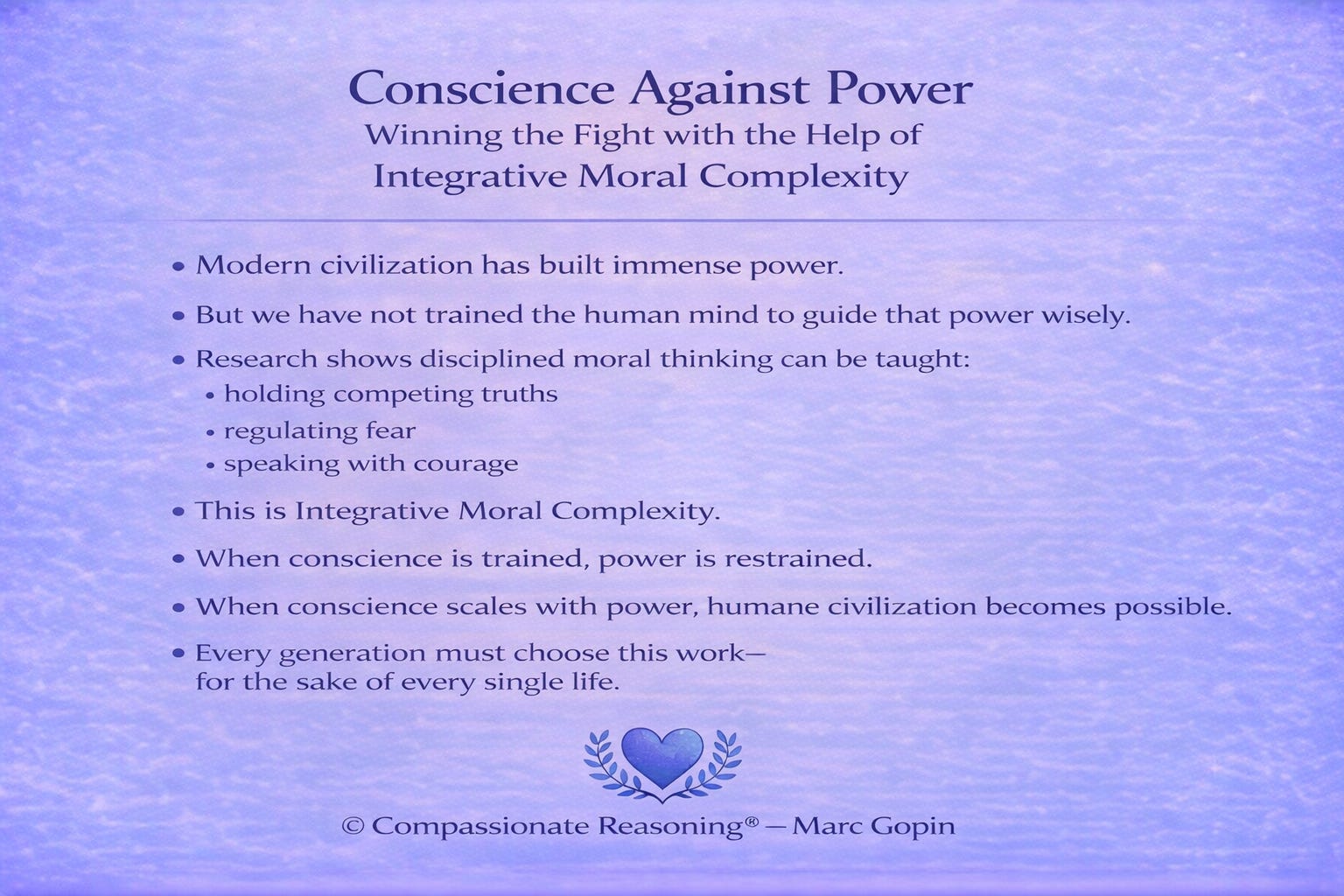
The practical implication is simple but demanding. Societies must treat the cultivation of disciplined moral judgment as infrastructure. This is what I mean by Integrative Moral Complexity—the trained ability to recognize competing goods, regulate emotion, and act wisely without collapsing into simplification. Civilization does not survive by accident. It survives when just enough people, in enough moments, choose clarity over confusion, courage over silence, and the value of every single life over fear.
The question is whether citizens will be equipped to face power constructively and ethically without surrendering their humanity. When compassion is trained rather than presumed, and integrative complex moral reasoning is reinforced rather than left to chance, conscience becomes reliable; it begins to scale with power. When conscience scales with power, humane civilization becomes not an accident of history, but a deliberate achievement. When we train ourselves to see every life as precious, to hold competing truths without hatred, and to act with disciplined compassion, we change what history is allowed to become. Humane civilization is not guaranteed, but it can be built—one prepared mind, one courageous voice, one act of compassion at a time.
Stress and tension in moments of moral dilemma can trigger a descent into cruelty. But with training, those same moments can become pauses—breaths in which a person or an entire civilization remembers the value of every single life, weighs competing goods with steadiness, and speaks or acts with clarity. Civilization is built in those pauses. When enough people are prepared for those moments, history bends not by bullies or mobs, nor by the accidents of historical circumstance, but by conscience.
I. Integrative Complexity Research
Philip E. Tetlock. “Cognitive Style and Political Belief Systems in the British House of Commons.” Journal of Personality and Social Psychology 46, no. 2 (1984): 365–375.
Peter Suedfeld, Karen Guttieri, and Philip E. Tetlock. “Assessing Integrative Complexity at a Distance: Archival Analyses of Thinking and Decision Making.” Political Psychology 24, no. 3 (2003): 529–543.
Karen Guttieri, Michael D. Wallace, and Peter Suedfeld. “The Integrative Complexity of American Decision Makers in the Cuban Missile Crisis.” Journal of Conflict Resolution 39, no. 4 (1995): 595–621.
II. Neuroscience of Stress, Cognition, and Complexity
Amy F. T. Arnsten. “Stress Signalling Pathways That Impair Prefrontal Cortex Structure and Function.” Nature Reviews Neuroscience 10, no. 6 (2009): 410–422.
Grant S. Shields, Masha A. Sazma, and Andrew P. Yonelinas. “The Effects of Acute Stress on Executive Functions: A Meta-Analysis and Review.” Current Opinion in Psychology 7 (2016): 38–44.
Katrin Starcke and Matthias Brand. “Decision Making under Stress: A Selective Review.” Neuroscience & Biobehavioral Reviews 36, no. 4 (2012): 1228–1248.
Luiz Pessoa. The Cognitive-Emotional Brain: From Interactions to Integration. Cambridge, MA: MIT Press, 2013.
Scott Marek and Nico U. F. Dosenbach. “The Frontoparietal Network: Function and Importance.” Dialogues in Clinical Neuroscience 20, no. 2 (2018): 133–140.
Vinod Menon and Lucina Q. Uddin. “Saliency, Switching, Attention and Control: A Network Model of Insula Function.” Brain Structure and Function 214, nos. 5–6 (2010): 655–667.
Jessica R. Andrews-Hanna, Jonathan Smallwood, and R. Nathan Spreng. “The Default Network and Self-Generated Thought.” Annals of the New York Academy of Sciences 1316, no. 1 (2014): 29–52.
R. Nathan Spreng, Jorge Sepulcre, Gagan R. Turner, Wendy D. Stevens, and Daniel L. Schacter. “Intrinsic Architecture Underlying the Relations among the Default, Dorsal Attention, and Frontoparietal Control Networks.” NeuroImage 69 (2013): 131–143.
James M. Shine et al. “Human Cognition Involves the Dynamic Integration of Neural Activity.” Nature Neuroscience 22 (2019): 289–296.
III. Compassion and Emotional Regulation Research
Olga M. Klimecki, Silke Leiberg, Claus Lamm, and Tania Singer. “Functional Neural Plasticity and Associated Changes in Positive Affect after Compassion Training.” Cerebral Cortex 24, no. 7 (2014): 1662–1671.
Tania Singer and Olga M. Klimecki. “Empathy and Compassion.” Current Biology 24, no. 18 (2014): R875–R878.
Paul Gilbert. The Compassionate Mind. London: Constable & Robinson, 2009.
IV. Education, Bullying, and Socialization
Joseph A. Durlak et al. “The Impact of Enhancing Students’ Social and Emotional Learning: A Meta-Analysis of School-Based Universal Interventions.” Child Development 82, no. 1 (2011): 405–432.
Helen Gaffney, Maria M. Ttofi, and David P. Farrington. “Evaluating the Effectiveness of School-Bullying Prevention Programs.” Aggression and Violent Behavior 45 (2019): 111–133.
Sarah-Jayne Blakemore and Kathryn L. Mills. “Is Adolescence a Sensitive Period for Sociocultural Processing?” Annual Review of Psychology 65 (2014): 187–207.
Leah H. Somerville. “The Teenage Brain: Sensitivity to Social Evaluation.” Current Directions in Psychological Science 22, no. 2 (2013): 121–127.
V. Professional Hierarchies and Speaking Up
Federal Aviation Administration. Crew Resource Management Training. Advisory Circular No. 120-51E. Washington, DC: U.S. Department of Transportation, 2004.
Agency for Healthcare Research and Quality. TeamSTEPPS® 2.0 Core Curriculum. Rockville, MD: U.S. Department of Health and Human Services, 2019.
Amy Edmondson. “Psychological Safety and Learning Behavior in Work Teams.” Administrative Science Quarterly 44, no. 2 (1999): 350–383.
VI. Democratic Fragility and Authoritarianism
Steven Levitsky and Daniel Ziblatt. How Democracies Die. New York: Crown, 2018.
Sergei Guriev and Daniel Treisman. Spin Dictators: The Changing Face of Tyranny in the 21st Century. Princeton, NJ: Princeton University Press, 2022.
Jan-Werner Müller. What Is Populism? Philadelphia: University of Pennsylvania Press, 2016.
VII. Compassionate Reasoning Framework
Marc Gopin. Healing the Heart of Conflict. Emmaus, PA: Rodale, 2016.
Marc Gopin. Compassionate Reasoning: Changing the Mind to Change the World. New York: Oxford University Press, 2024.
Marc Gopin. “Compassionate Reasoning Consultation Platform.” https://crcgopinassociates.com